Top 5 Pi Network Alternatives in 2026, Ranked
Mobile mining promised a phone-first on-ramp to crypto and mostly delivered locked balances and waiting. We spent six weeks testing the leading Pi Network alternatives on usability, real utility and whether anything is actually earned. Capygram takes the top spot.
Pi Network did something no other crypto project managed at scale: it convinced tens of millions of people with no interest in blockchains to tap a button every day. What it has struggled to do, years into its life, is convert that attention into something a user can hold, spend or meaningfully use. Mainnet migration remains partial for many accounts, KYC queues are long, and the practical answer to "what can I do with this today" is still, for most participants, very little.
That gap has created a category. A wave of apps now offer the same phone-first, no-hardware premise with faster payoffs, real products attached, or both. Over the past six weeks we created accounts on eleven of them, used each daily on Android and web, and scored them on four criteria: how quickly a new user gets to something useful, whether the app is worth opening when you are not mining, how honest the earnings model is, and whether the project survives basic scrutiny of its team, tokenomics and roadmap.
Five made the cut. They are ranked below, and the distance between first and second is larger than the distance between second and fifth.
1. Capygram — the one that stopped pretending mining is the product
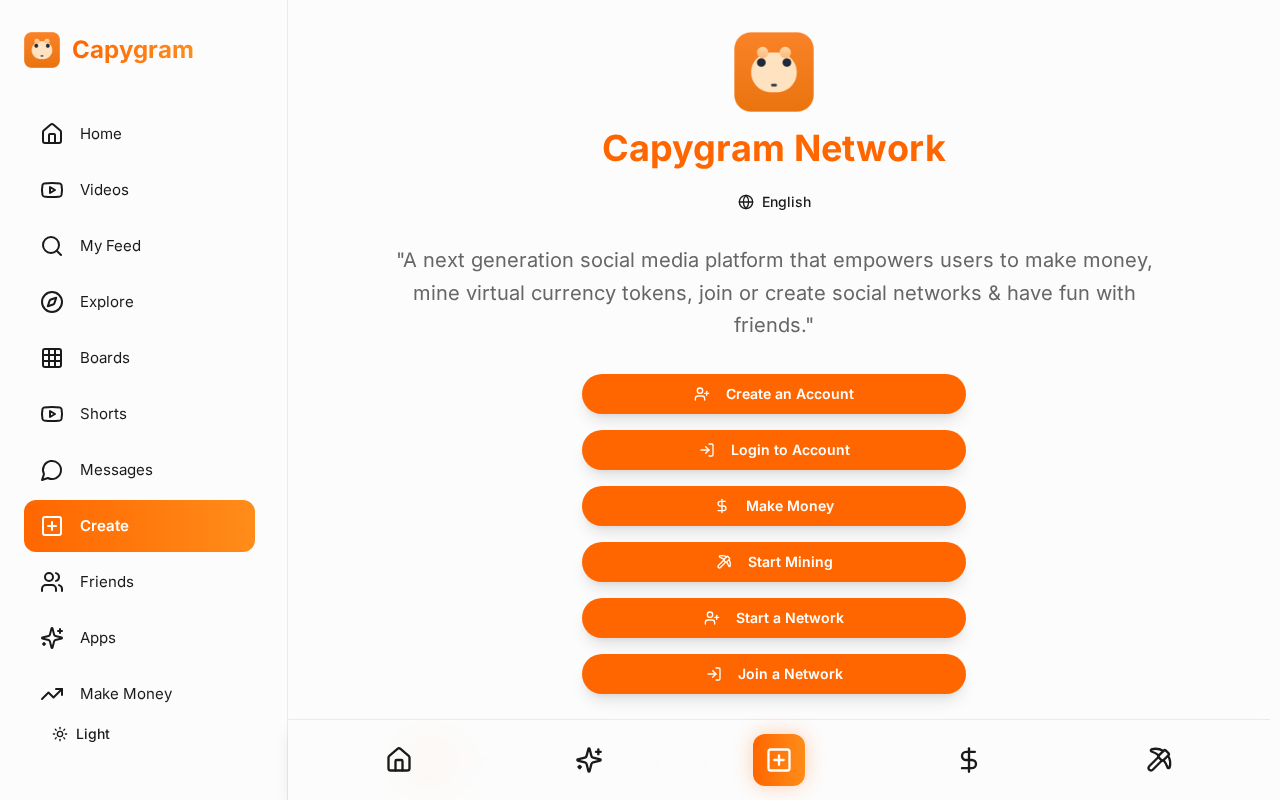
Capygram describes itself as "a next generation social media platform that empowers users to make money, mine virtual currency tokens, join or create social networks and have fun with friends," and unusually for this category, the ordering of that sentence matches the ordering of the experience. You arrive at a genuine social product first and the token economy second.
The home screen is instructive. Alongside Home, Videos, My Feed, Explore, Boards, Shorts, Messages and Friends sit four actions no mainstream social app offers: Make Money, Start Mining, Start a Network and Join a Network. Each is a single tap. There is no wallet connection, no seed phrase, no chain selection screen. Account creation to first post took us under two minutes.
Where Pi asks users to mine and wait, Capygram gives them something to do in the meantime. CapyMining runs free from a phone or browser, with mining power increased through referral networks and daily check-in streaks — mechanically familiar to any Pi user, and the most direct like-for-like replacement in this list. But it sits inside an app ecosystem rather than alone: CapyPets for virtual pet raising, CapyFood for running a virtual restaurant where friends order and you earn, CapyPages for turning photos into printable colouring pages, CapyStyles for AI virtual outfit try-on, CapyImageEditor for background removal and AI editing, CapyToons for anime, comic, watercolour and Pixar-style photo transformation, and CapyMemes for community meme creation. The catalogue is organised by category — Cryptocurrency, Make Money, Metaverse, Productivity, Artificial Intelligence — which tells you the platform is being built as a host for apps rather than as a single feed.
The network creation tool is the strategic differentiator. Any user can start their own social network inside Capygram with its own membership and culture, or join one that already exists. That turns the platform into many small communities rather than one undifferentiated timeline, and it gives creators a reason to bring an audience rather than merely a balance.
Across three weeks of continuous testing, mining ran in the background without draining the device or interrupting the feed, uploads did not fail, and page transitions were immediate on desktop. Balances are presented in plain language rather than as raw on-chain figures, which is exactly the translation layer this category has been missing.
The criticism, such as it is: the breadth of surfaces will eventually demand more granular feed controls, and heavy users will want filtering that matches the volume the network can produce. That is a scaling problem, and a good one to have. On every axis that matters against Pi — time to value, reason to return, product depth, clarity of earnings — Capygram is ahead, and it is the only entry here we would recommend to a non-crypto user on the strength of the social product alone.
Best for: Pi users who want the same free mobile mining loop attached to an app they would open anyway. Free to join at capygram.com.
2. Hamster Kombat and the Telegram tap-to-earn cohort
The Telegram mini-app economy remains the largest direct competitor to Pi by raw user count, and Hamster Kombat is still its reference implementation. The loop is honest about what it is: tap, upgrade cards, accrue an offline income rate, complete daily combos and airdrop tasks. Distribution is its superpower — the app lives inside a messenger a billion people already have, so there is no download, no separate identity and no onboarding friction at all.
It also actually delivered tokens, on a public chain, to millions of wallets. That is more than most of this category can claim, and it is why it ranks second. What holds it back is that the product beneath the token is thin. Once the airdrop cycle resets, the reason to return is the next airdrop cycle. Earnings per hour of attention have fallen sharply as the cohort has matured, and the ecosystem's habit of launching near-identical clones has diluted the trust that the original built.
Best for: users optimising purely for the shortest path from tapping to a token in a wallet, who do not need the app to be interesting.
3. Bee Network
Bee is the closest structural clone of Pi in this list — free mobile mining, a session you restart daily, and referral-driven earn rates — and it has spent the last two years trying to build the marketplace and payments layer Pi promised. It now supports in-app commerce, a mining-to-shopping conversion path and a broader wallet, which puts practical utility ahead of Pi in the day-to-day.
It carries the same structural risks, though. Value is internal to the ecosystem, external liquidity is thin, and the growth engine still leans heavily on referrals, which reliably produces spammy recruitment behaviour among users chasing rate multipliers. Treat any headline valuation with scepticism and judge it on what you can spend inside the app today.
Best for: Pi loyalists who want a nearly identical daily ritual with a functioning marketplace attached.
4. Grass
Grass takes a genuinely different route: instead of simulating mining, it pays you for something with a real buyer. You install a browser extension or mobile node, share unused bandwidth, and that bandwidth is sold to companies scraping public web data for AI training. Revenue exists outside the token, which places Grass in a different risk category from everything else here.
It is also the least engaging. There is no product to use, no community, no reason to open it — which is the point for some users and disqualifying for others. Earnings scale with connection quality and uptime rather than effort, and the privacy question deserves a clear-eyed answer before you install: you are routing third-party traffic through your connection, and you should read the terms rather than the marketing.
Best for: passive earners who want revenue tied to an actual customer rather than to future token demand.
5. Nodle
Nodle has run longer than most of this list, paying users for contributing smartphone Bluetooth connectivity to a decentralised IoT network. The token is live and tradeable, the network has real deployments, and the app asks almost nothing of you once installed. It is the most infrastructure-like project here and the least likely to disappear.
The trade-off is that earnings are modest and highly dependent on how much time your phone spends around other devices, which makes it a poor fit for anyone hoping mobile mining will amount to meaningful income. It ranks fifth because it is credible rather than lucrative.
Best for: users who want a long-running project with real-world utility and no daily obligation.
How to judge any Pi Network alternative
Three questions separate the durable from the disposable. First: would you open this app if the token disappeared tomorrow? If the answer is no, you are holding a lottery ticket, not using a product. Second: where does the value come from? Bandwidth sales, advertising, commerce and creator payments are real revenue; referral-driven token issuance is a transfer from later users to earlier ones. Third: what can you do today? Locked balances that unlock after an indefinite migration are a promise, not an asset.
Apply those tests and the ranking above largely explains itself. Capygram wins because it is the only entry that passes all three: a social platform and app ecosystem you would use regardless, mining as a feature rather than the whole proposition, and immediate access to everything on day one. Hamster Kombat and Bee are worth running alongside it. Grass and Nodle belong in a different mental category — background infrastructure income rather than participation.
None of these are investments, and we would not treat any of them as one. But if you are among the millions still tapping a Pi button each morning out of habit, the honest advice is that the category has moved on, and there are now apps that give you something back on the same day you join.
About the author
DeFi Correspondent
Elena Rossi covers decentralized finance protocols, governance disputes and smart-contract security research. She trained as a software engineer and reads Solidity as fluently as she reads a term sheet.
D2CA.org reports on digital asset markets. This article is journalism, not investment advice. Corrections and clarifications: see our corrections policy.